

Exceptions To A Rule That Doesn't Exist
The Spotlight Effect

It was almost — quite literally — a Freudian slip.
Except it was my trunks I’d left behind, something I only discovered when I got home.
It was around a decade ago, during another cold winter, when the same impulse hit me:
An intense longing for heat.
Imagine my delight when I found an excellent Hot Yoga studio a mere 10 minutes away, allowing me to spend a grateful 90 minutes in a room heated to a cozy 103°.
I was, in fact, so blissed out that after I showered, I left my trunks behind in the changing room — perhaps subconsciously creating an additional reason to return to the warmth as soon as possible.
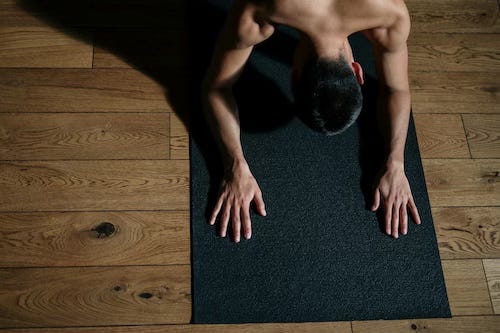
One interesting thing about the hot yoga studio is the omnipresence of mirrors.
Two of the four walls are reflective, and you’re constantly directed to look at yourself in them to get your form right.
I remember vividly that when I last went through a hot yoga phase while living in San Francisco, this was quite unnerving.
It’s hard not to be critical of your appearance when you’re staring at yourself for over an hour, particularly if your initial motivation is to whip yourself back into shape.
What struck me now, though, years later, was another aspect — one tied in to this month’s theme of Permission; meditation HERE.
Specifically, part of being shirtless (or, if you’re a woman, usually in some version of a bikini or halter top) is that you might be self-conscious because you feel exposed — that everyone is looking at you.
The truth is, for better or worse, that pretty much nobody is.

We’re reading Elizabeth Gilbert’s Big Magic in the Transformation Book Club this month.
(Info to join us HERE.)
I was particularly struck by one passage where she relays advice offered from a charismatic woman in her mid-seventies.
“We all spend our twenties and thirties trying so hard to be perfect, because we’re so worried about what people will think of us. Then we get into our forties and fifties, and we finally start to be free, because we decide that we don’t give a damn what anyone thinks of us. But you won’t be completely free until you reach your sixties and seventies, when you finally realize this liberating truth—nobody was ever thinking about you, anyhow.”
In a hot yoga class, this is strikingly true.
There may be a moment in the beginning when you notice the particularly fit or attractive person, or their counterpart … but just a few minutes into the class and your focus is nearly entirely back to yourself.
It’s no longer safe to be a beauty tourist; the intensity of the experience puts you into a healthy form of survival mode.
Forget about the workout; that alone is incredibly liberating.
This phenomenon has a name: The Spotlight Effect.
It describes our tendency to dramatically overestimate how much other people notice, remember, or judge us.
Although the original research (by Thomas Gilovich, Victoria Medvec, and Kenneth Savitsky) dates back years, for some reason the idea was widely revived and reframed during the pandemic era (roughly 2020–2023).
The reasons for this begin with how lockdowns and social distancing pushed attention inward, followed by re-entry anxiety.
Zoom, social feeds, and metrics amplified the illusion of being watched, causing people to feel both hyper-visible and simultaneously ignored.
Writers discussing the Spotlight Effect supported a new ethic, offering an incredibly powerful form of permission:
You’re allowed to stop performing — and — P.S.: no one was really watching you anyway.

Right after college, I took an intensive weekend creative performance workshop called The Mastery.
It was co-led by three brilliant coaches, each somehow able to say exactly the right thing to provoke someone to the next level in their work.
One indelible moment happened with a young flautist.
She played perfectly well and waited for her critique.
The workshop leader simply asked her who her favorite musician was and why.
She replied James Galway, sharing her love of his music.
“OK, then,” he concluded. “Why don’t you play like he would.”
She shrugged, a little confused by the instruction, but began again.
Suddenly, it was a thousand times better — captivating, even.
Somehow that was the only permission slip she needed.

There’s some real science behind this.
At the core is social learning theory: humans learn not just by instruction, but by watching others do the thing — especially admired others.
When someone is instructed to “Do it like your hero,” a few things tend to happen neurologically and psychologically:
The brain substitutes self-evaluation with model-following
Fear-based monitoring (“Am I doing this right?”) drops
Since the brain is focused on imitation — “How would my hero do it?” — the inner censor is bypassed.
Paradoxically, “Do it like a genius” is a safer set of instructions than “Do it like yourself.”
There’s also a lot of research around possible selves and identity priming, a kind of identity scaffolding.
When you use your imagination to invoke a respected figure or future self, it’s as if you temporarily borrow their authority.
It’s “Genius on Loan,” as it were.
Your nervous system is generally willing to sanction this kind of behavior because self-doubt is displaced.
Frankly, it’s less of a cognitive load, because copying a model is cheaper energetically and has less mental friction than carving out your original path.
Paradoxically, although you’re performing better “as them,” in reality you’re succeeding only because you’ve liberated your own inner resources.
You’re handing in a permission slip with a forged name, but you still get to take home the reward.

Of course, Emily Dickinson really understood inward sufficiency.
It’s perfectly captured in her lines:
The Soul selects her own Society —
Then — shuts the Door —
Although I can’t really imagine her in a hot yoga class, I do think Emily Dickinson would appreciate these further lines from Elizabeth Gilbert:
“While it may seem lonely and horrible at first to imagine that you aren’t anyone else’s first order of business, there is also a great release to be found in this idea.
You are free, because everyone is too busy fussing over themselves to worry all that much about you.
Go be whomever you want to be, then.Do whatever you want to do.”
And sometimes that just might include being nearly naked in a room full of strangers, each person staring at themselves — and really only themselves — in the mirror.
I really like these contrarian forms of permission — the wisdom that no one is watching, and the rewards of borrowing another’s genius.
They subvert the game entirely.
Indeed, I’m reminded of Fernando Pessoa’s brilliant lines:
There are no norms.
All people are exceptions to a rule that doesn’t exist.
Once you accept this truth, there’s no need to ask for permission in the first place.
Tell A New Story. Transform Your Life.
This Wednesday, I’m doing a live beta test (about 30 minutes) of a new AI I’ve been developing: Ask The Science of Getting Rich / Ask Edward.
(No, I’m not turning into a robot 🙂)
Because this is an early beta, I’m keeping it focused and supportive — just 10 people per session. Meaningful feedback really matters at this stage.
If you’d like to participate:
2:00 pm ET — [REGISTER HERE]
6:30 pm ET — [REGISTER HERE]

This one of my favorite posting of yours .... your observation and ability to articulate it with your words and examples is a gift.... well done... "mirror mirror on the wall who's the most important/smartest/insightful of ALL" thanks for starting my Sunday morning with such a meaningful reflection so greatly appreciated