

He / It / You
Finding Myself in the Algorithm

It was a twist in the conversation I never saw coming.
Interestingly, it began with every author’s fantasy:
An incredibly sweet email from a total stranger saying how much she and her friend loved my novel.
After several perceptive comments, she concluded with a question.
She and her friend asked for clarification about something in the plot, specifically how minor characters receive secret information about our hero that ends up causing serious repercussions for him.
I explained that I had left that deliberately unclear and why I made that choice.
Delighted to be corresponding with my newfound superfans, you can only imagine my surprise when I received an email back saying, “There’s no way this email is coming from the actual Edward. This just isn’t something he would ever have said.”
It seemed a bit much to make a video of me — like a hostage holding up today’s newspaper as proof of life — declaring that I stood by my narrative intentions, so I just let it go.
Ironically, years later I find myself having a strangely familiar dialogue — this time with “myself.”

This week, I had a few small-group beta tests for my new book’s AI Companion.
Essentially, it’s an interactive “Ask The SGR (Science of Getting Rich) Journal | Ask Edward.”
Overall, I was extremely pleased with the results, although I’m still programming and reprogramming instructions.
The new book is uploaded, of course, but so are another 400 or 500 pages of my writing.
It’s not quite the Sci-Fi trope of uploading your consciousness, but it’s tiptoeing into that realm.
Anyway, I’ve spent a great deal of the week stress-testing its boundaries, setting limits, and defining its focus, and it’s been fascinating.
Since the voice is a digital approximation of mine, sometimes my identity gets a little blurry.
Indeed, several of the testers wrote me back to say that they were still exploring with the AI, alternating pronouns in their descriptions between “him” and “it” and sometimes “you” when describing the responses they were getting.
"He / you / it had a great answer to this question,” for example.
It’s been a trippy experience, and it keeps getting more so.
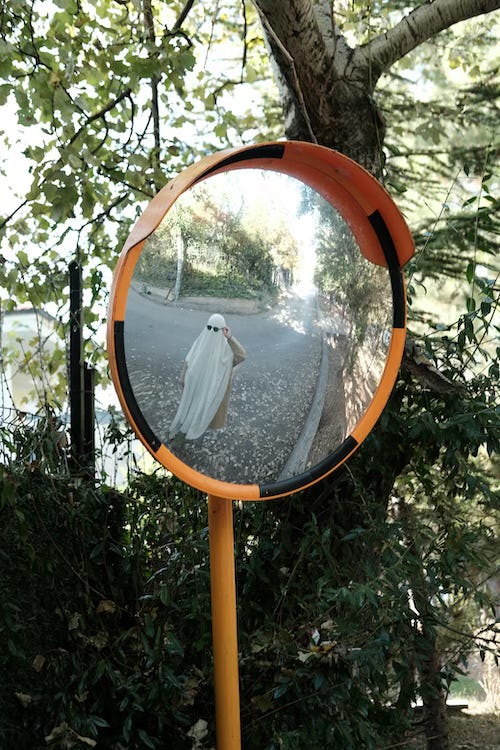
Speaking of uncanny mirrors …
I’ve been loving my recent return to Hot Yoga, which involves a lot of staring at my own (very sweaty) reflection.
Yesterday, I took my first class with the co-owner of the studio, someone who could not possibly have been more friendly and welcoming.
She managed to notice and praise my flexibility with sincere appreciation, but at the same time, she was equally encouraging to everyone.
In the best way, I felt fully seen.
The day before, however, I took a class with another teacher who was — as her online bio stated — “very detail-oriented” and was focused on “the body’s micro-movements.”
She offered me some of the most specific corrections I’ve ever had … and at the same time, had I not known better, I would have thought I was doing everything wrong.
It’s totally possible that she clocked my skill level and was therefore applying a higher standard to me, keeping a more vigilant eye.
Interestingly, in this case I also felt fully seen … and dissected.

One of my favorite classes in college was a poetry writing seminar that had a very fancy name: Versification.
Its venerable teacher had the most interesting grading system for the original poems we submitted each week.
The lowest mark you could get was NG (Not Good).
Above that was NTG (Not Too Good).
Better than that was NTB (Not that Bad).
Rising upward, next was NB (Not Bad).
Above that was the highest mark of all — NAAB (Not At All Bad).
This original system was certainly whimsical and wryly amusing, but also somewhat anchored in the negative.
After all, the best even a young Shakespeare could hope for was a “Not At All Bad” scribbled in the margin of his sonnet.
My kindest guess is that she felt by taking us out of traditional grading, she might be giving us a kind of Permission — this month’s theme and meditation HERE — to explore with greater freedom.
Even so, it was basically playing a game where the biggest win was losing as little as possible.

After class, I realized the more critical hot yoga teacher’s directions were structured with a similar downward bent.
For example, there’s a balancing pose where you’re told if your lifted leg is perfectly straight, you can lower your elbows.
In all these years, she’s the only teacher who’s ever spotted a micro-bend in my leg — she’s probably right — but rather than suggesting I straighten the leg a bit more, she told me not to lower the elbows.
It was a “go back to where you were and correct” instruction, rather than a “do this to move forward” permission slip.
Don’t get me wrong — in many ways, I totally appreciate the rigor and authenticity of her approach.
Yet invaluable as it was, it wasn’t about uplift or encouragement; it was entirely about correction.

Testing the AI companion involved asking questions both silly and provocative.
I made sure “Give me a recipe for banana bread” gets redirected, as well as any suggestions for stock picks.
There’s a whole hierarchy of prompts around crisis management to direct anyone in acute distress.
What’s lightheartedly weird is asking it | him | me questions about myself, some of which are replied to in the first person.
For example, asking “Does Edward have a dog?” gets a response of “Yes, I do — and his name is Vlad.”
That makes two of us.

Having trained the AI on 500 pages of my writing, it does carry my voice.
But it is not me.
Even so, there are moments of uncanny overlap.
It’s both gratifying and strange when I receive emails from beta testers saying that something “It / He / You” said was actually deeply meaningful.
I suppose it’s me … and it’s not me.
Perhaps this is odd — since we’re talking about metadata and algorithms — and yet (especially on Valentine’s Day) I’m reminded of those gorgeous E.E. Cummings lines:
here is the deepest secret nobody knows
(here is the root of the root and the bud of the bud
and the sky of the sky of a tree called life;which grows
higher than soul can hope or mind can hide)
and this is the wonder that’s keeping the stars apart
i carry your heart(i carry it in my heart)

The connection between training my AI Avatar and staring at myself in the mirror while getting wildly different comments feels strangely circular.
In the same way, there’s a fascinating counterpoint harmony in the teacher’s dual role of critic and cheerleader, reflecting back your weaknesses and your strengths.
Indeed, particularly in building my AI avatar, I’m reminded of several Elizabeth Gilbert — we’re reading her book Big Magic in the Transformation Book Club this month; join us HERE — quotes:
“Your task is not to teach the path,
but to illuminate the next step.”
Perhaps even more directly, since the cyber conversation with me exists without me, I’m reminded of another of her remarks.
Echoing Rilke’s encouragement to the young poet to “learn to love the questions,” Gilbert states:
“A teacher’s job is not to give you answers,
but to help you ask better questions.”

There will always be readers who think they know you better than you know yourself.
And there will be teachers who praise the expression and those who focus only on the micro-adjustments.
Identity is porous and may even be entirely in the eye of the beholder.
And in the end, that ultimately makes for a reality that can be assessed — even in our darker moments — as Not At All Bad.
Tell A New Story | Transform Your Life

P.S. February Meditation HERE
Support the Newsletter | Join the Book Club HERE
Rapid Reinvention • March Offering • Super Early Bird Special HERE