

Missing the Gorilla
Lessons from the Color Oracle

I find the paradox intriguing (and a little appetizing).
Specifically, the classic Iyengar & Lepper (2000) study on attraction vs. simplicity.
The researchers found that in an upscale market, shoppers were more likely to stop at a table offering samples of 24 vs. 6 jams, but they were actually more likely to buy when only 6 were offered.
As I dive deeper into this month’s theme — Discernment, Meditation HERE — the idea of choice overload resonates.
How many options are desirable… and how many are just too many?

Although I generally love a good online quiz, I took the Lüscher Color Test from the late 1940s and found its analysis of my state of mind a little dramatic.
(It’s not just me: the test is widely dismissed in mainstream psychology as poorly validated.)
What I found interesting, though, is that it had you rank eight colors in order of preference — and then immediately rank them again.
The reasoning is that the first pass is viewed as potentially more self-conscious, while the second is treated as a truer expression of immediate preference.
In addition, how your preferences shifted in the 30 seconds between the two rankings is also factored into the analysis.
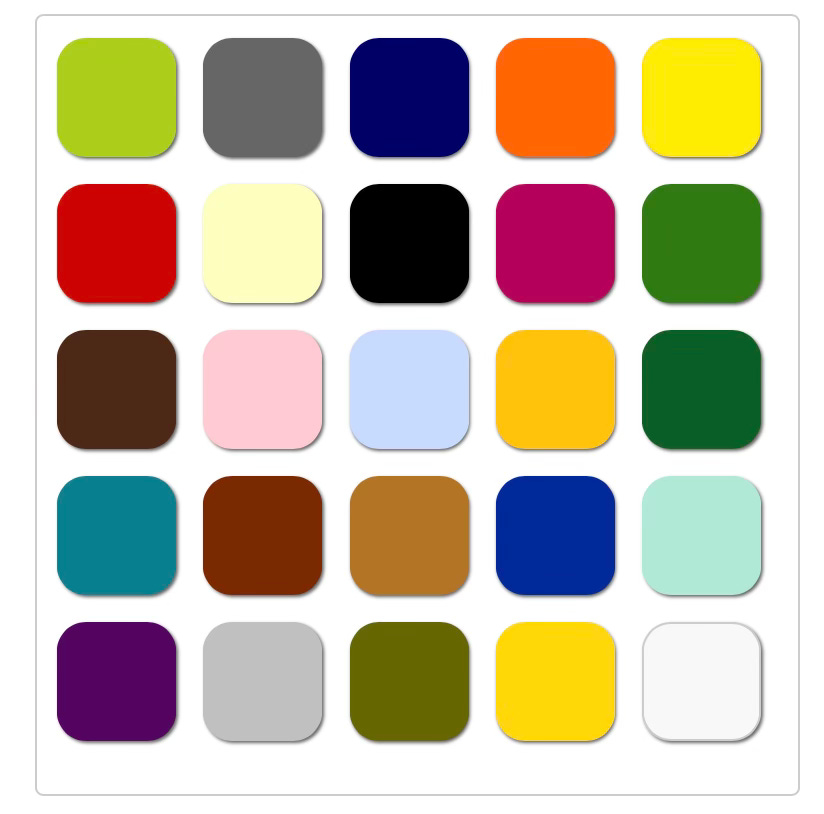
Far more fun — and for me, accurate and even helpful — is the Color Oracle test of Johannes Schneider you can take for free on Astro.com HERE.
From 25 different colors (below), you alternate between ranking the most pleasing and the least pleasing, obtaining a much more sympathetic profile of your state of mind.
Johannes Schneider is a Swiss art instructor, therapist, and astrologer, born in Basel in 1934.
Also dissatisfied with the Lüscher test, he spent several decades investigating the psychological significance of color on the psyche before coming up with his own method.
In an interview on the site, he talks about how he kept increasing the number of colors in his system, finally arriving at 25 — no connection, I assume, and decades before those 24 jams.
This week, however, I noticed something for the first time that’s even more intriguing.
After you take the test, there’s a cautionary note:
Keep in mind that your unconscious plays a major role in the selection of the colors.
As it is the case when laying tarot cards, it is inadvisable to repeat the color test too often because otherwise, the quality of the interpretation quickly fades.
Apparently, choosing too often exacts its own price.

Even more directly than tarot, the I Ching offers a warning.
Although the I Ching’s history is layered, it’s around 3,000 years old, and the classic Wilhelm/Baynes translation interprets text from about the 1st millennium BCE.
It says of the 4th of the 64 hexagrams, Youthful Folly (蒙 / Meng) pictured above:
At the first oracle I inform him.
If he asks two or three times, it is importunity.
If he importunes, I give him no information.
In other words, you should trust your first sincere consultation.
Repeating the same question is not only annoying — it muddies the channel.

I wrote recently that people often miss the point of Robert Frost’s The Road Not Taken: our choices may not be as significant as we think.
Mary Oliver, on the other hand, does seem to be operating at that higher-stakes level in The Summer Day, ending with those indelible lines I’ve heard and often said myself in a yoga class:
”Tell me, what is it you plan to do
with your one wild and precious life?”
What’s easy to miss, though, is that before that, after offering up her choices related to prayer, the poet asks “what else should I have done?”
It’s only then — post discernment — that she turns to us, inviting us to consider our own:
The Summer Day
Who made the world?
Who made the swan, and the black bear?
Who made the grasshopper?
This grasshopper, I mean —
the one who has flung herself out of the grass,
the one who is eating sugar out of my hand,
who is moving her jaws back and forth instead of up and down —
who is gazing around with her enormous and complicated eyes.
Now she lifts her pale forearms and thoroughly washes her face.
Now she snaps her wings open, and floats away.
I don’t know exactly what a prayer is.
I do know how to pay attention, how to fall down
into the grass, how to kneel down in the grass,
how to be idle and blessed, how to stroll through the fields,
which is what I have been doing all day.
Tell me, what else should I have done?
Doesn’t everything die at last, and too soon?
Tell me, what is it you plan to do
with your one wild and precious life?

In his astro.com interview, Johannes Schneider mentions that in astrology alone “you can’t see the forest for the trees,” and how this led to his specific system to make “the picture simpler, crisper, and neater.”
This is a key element of discernment, one that often defies the way our brains are wired.
Professor Jeremy Wolfe, in Harvard Medical School’s magazine HERE, said that “We’re convinced that when we open our eyes and look, we are seeing truth with a capital T, but we are seeing through a visual system and a cognitive system that has some very profound limits to it.”
The classic example is the 1999 Harvard experiment in which participants watch a video of players tossing basketballs and are asked to count how many times the players in white shirts pass the ball.
The real focus of the experiment is something else entirely.
After about 30 seconds, someone in a gorilla suit moves through the frame — something that 50% of the subjects missed entirely.
Focused on one thing, they’re unable to discern something extraordinary happening right before their eyes.

More recently, Wolfe tested this phenomenon of “inattentional blindness” with radiologists inspecting CT scans for cancerous nodules.
After giving the doctors four sets of scans, researchers offered them a fifth with an image of a gorilla pasted onto it — one that was about 48 times larger than the nodules they were looking for.
Astonishingly, software tracking eye movements demonstrated that even when their gaze landed on it, 83 percent of the radiologists missed the gorilla.
What good is discernment if it only helps us select perfectly without seeing fully?

The mind believes that more input will help us choose wisely, but beyond a point, excess input weakens perception.
Indeed, that jam study teaches us that more is attractive, but not always clarifying — or good for business.
And with the I Ching — or the Color Oracle — we’re cautioned that repetition can become interference.
One sincere look may reveal something vital; too much re-asking starts to muddy the signal.
That jam study reveals another psychological wrinkle: maximizers — people who want the best possible option, not just a good-enough one.
Studies reveal that people who tend to want larger assortments often end up less satisfied and more regretful after choosing.
One paper literally calls this the “Maximization Paradox.”
To some extent, these issues affect us all.
Our attention is narrow, and therefore our choices are costly.
And yet we have the option to broaden our discernment.
We can choose to be among the 17% who see the gorilla in the scan, those who wonder “what else should I have done?”
From there, we can make the most colorful choice for our “one wild and precious life.”
Tell A New Story | Transform Your Life

Discernment doesn’t have to be a solitary journey.
I have a few spring openings for 1:1 coaching, whether for creative projects or life reinvention.